- installation
- environment variables
- config in osx
- version change
- extension
- python IDLE in MacOS Big Sure
- venv
reference:
installation
command completion
$ python -m pip completion --bash >> ~/.bashrc

# or
$ python -m pip completion --bash >> ~/.profile

# or
$ eval "$(pip completion --bash)"
with pyenv
# install pyenv
$ curl https://pyenv.run | bash
# or
$ git clone https://github.com/pyenv/pyenv.git ~/.pyenv
# or
$ brew install pyenv

# setup environment
# -- ~/.bash_profile -- #
test -d "${HOME}/.pyenv"  && export PYENV_ROOT="$HOME/.pyenv"
test -d "$PYENV_ROOT/bin" && export PATH="$PYENV_ROOT/bin:$PATH"
type -P pyenv >/dev/null  && eval "$(pyenv init - bash)"

# install python
$ pyenv install 3.12.11
$ pyenv global 3.12.11

# pip/pipx
$ python -m pip install --upgrade pip pipx
$ python -m pipx ensurepath

# -- others -- #
$ pyenv install --list
$ pyenv versions
using in local or shell
# local
$ pyenv local 3.10.14
# shell
$ pyenv shell 3.10.14

# install modules with pipx
$ pipx install --python "$(pyenv which python)" --suffix=@3.10 pre-commit

# using poetry with pyenv
$ poetry env use "$(pyenv which python)"
$ poetry install
# execute
$ poetry run python -m cli.crm --help
using system python version
$ mkdir -p ~/.pyenv/versions/system-3.11/bin
$ ln -sf /bin/python3.11 ~/.pyenv/versions/system-3.11/bin/python
$ ln -sf /bin/python3.11 ~/.pyenv/versions/system-3.11/bin/python3
$ ln -sf /bin/python3.11 ~/.pyenv/versions/system-3.11/bin/python3.11

# switch to system python
$ pyenv rehash
$ pyenv global system-3.11

# check
$ pyenv which python
$ pyenv which python3
$ pyenv which python3.11
install from source code
[!NOTE|label:references:]
- * Python Developer's Guide: Compile and build
- * Python Developer's Guide: Install dependencies
- Python 3.3 source code setup: modules were not found: _lzma _sqlite3 _tkinter
- Building python from source on Ubuntu 20.04 LTS Focal Fossa
- How to Install Python 3 on Ubuntu 20.04 or 22.04
- How to Install Python 3.8 on CentOS 8
basic environment prepare
# centos
$ sudo dnf groupinstall 'development tools'
$ sudo dnf install gcc openssl-devel bzip2-devel libffi-devel \
$ sudo dnf install expat-devel gdbm-devel ncurses-devel \
                   readline-devel sqlite-devel tk-devel xz-devel zlib-devel

# ubuntu
$ sudo apt install build-essential checkinstall pkg-config \
                   libexpat1-dev libncursesw5-dev libssl-dev \
                   libreadline8 libreadline-dev libsqlite3-dev \
                   tk-dev libgdbm-dev libc6-dev libbz2-dev \
                   libnss3-dev zlib1g-dev
download source code
$ curl -O https://www.python.org/ftp/python/3.8.3/Python-3.8.3.tgz
$ tar xzf Python-3.8.3.tgz

# or
$ PYTHON_VERSION='3.12.2'
$ curl -fsSL https://www.python.org/ftp/python/${PYTHON_VERSION}/Python-${PYTHON_VERSION}.tgz |
  tar xzf - -C /opt/python &&
  cd /opt/python/Python-${PYTHON_VERSION}
compile and install
[!NOTE|label:references:]
- How to build your own Python version
- docker-library/python/Dockerfile
# debian gnuArch="$(dpkg-architecture --query DEB_BUILD_GNU_TYPE)" - * 3. Configure Python
- Shared libraries in macOS and Linux
DYLD_LIBRARY_PATHin osxLD_LIBRARY_PATHin linux- Search Path Used by Windows to Locate a DLL)
$ ./configure --enable-optimizations \ --enable-shared \ # or export PYTHON_CONFIGURE_OPTS="--enable-shared" --with-lto \ --with-system-expat \ --with-ensurepip \ --with-openssl=/usr/lib/ssl $ sudo make -j "$(nproc)" $ sudo make install $ export PYTHON_HOME='/opt/python/Python-3.12.2' # for libpython3.12.so.1.0 $ export LD_LIBRARY_PATH=$PYTHON_HOME:$LD_LIBRARY_PATH # check $ which -a python3.12 /usr/local/bin/python3.12 $ python3 --version Python 3.12.2 # upgrade pip $ sudo -H /usr/local/bin/python3.12 -m pip install --upgrade piplinker cache
[!NOTE|label:references:]
- Python3.7: error while loading shared libraries: libpython3.7m.so.1.0
$ sudo ldconfig -v
$ sudo ldconfig /usr/local/lib
$ sudo ldconfig -v | grep python libpython3.so -> libpython3.so libpython3.6m.so.1.0 -> libpython3.6m.so.1.0 $ sudo ldconfig -v /opt/python/Python-3.12.2 | grep python /opt/python/Python-3.12.2: (from <cmdline>:0) libpython3.so -> libpython3.so libpython3.12.so.1.0 -> libpython3.12.so.1.0 libpython3.so -> libpython3.so libpython3.6m.so.1.0 -> libpython3.6m.so.1.0- Python3.7: error while loading shared libraries: libpython3.7m.so.1.0
setup
$ sudo update-alternatives --install /usr/bin/python3 python3 /usr/local/bin/python3.8 99
upgrade in osx
homebrew
[!NOTE|label:references:] verify dependents → rebuild → remove the old python
# who still depends on the old python
$ brew uses --installed python@3.14

# rebuild/re-bind to the new python
$ brew reinstall <formula1> <formula2> ...

# re-verify until empty
$ brew uses --installed python@3.14              # goal: empty or just python-tk@3.14

# drop companion packages + the old python
$ brew uninstall python-tk@3.14
$ brew autoremove
$ brew uninstall python@3.14
pipx
[!NOTE|label:
No module named piponupgrade[-all]] pipx creates each app venv with--without-pipand sharespip/setuptoolsfrom a single venv (~/.local/pipx/shared), wired into every app venv via apipx_shared.pthfile. After a Python minor bump the shared venv is rebuilt under the newpythonX.Y, yet any app venv whose interpreter still runs keeps its old.pth(e.g. still pointing at the now-deleted.../shared/lib/python3.14/site-packages) →pipx upgrade[-all]then fails withNo module named pip. Note onlyreinstall-allrewrites that.pth:
pipx repair— rebuilds only venvs whose interpreter cannot run, so it skips these.pipx upgrade-shared— rebuilds the shared venv only; it does not touch the app.pth.pipx reinstall-all— recreates every app venv, writing a fresh.pthon the new python.
# upgrade packages with new python
$ pipx reinstall-all --python python3.15

# the shared venv's interpreter is invalid → pipx rebuilds it on the new python
$ pipx repair --python python3.15
$ pipx upgrade-shared
$ command cat ~/.local/pipx/shared/pyvenv.cfg | grep -E '^(home|version)'   # should show the new minor
# detect: app venvs whose shared .pth points to a now-missing pythonX.Y dir (exactly the ones that fail `pipx upgrade[-all]` with "No module named pip")
$ for f in ~/.local/pipx/venvs/*/lib/python*/site-packages/pipx_shared.pth; do
    d=$(command cat "$f"); [[ -d "$d" ]] || printf '%s -> %s (MISSING)\n' "$f" "$d";
  done
# ── or ───
$ cd "${HOME}/.local/pipx/venvs"
$ for v in commitizen pylint pdf2docx typos ansible poetry thonny pdfminer-six pre-commit terminal-colors; do
    for pth in "${v}"/lib/python*/site-packages/pipx_shared.pth; do
      if [[ -f "${pth}" ]]; then
        target=$(command cat "${pth}")
        [[ -d "${target}" ]] && status=OK || status=MISSING
        printf '%-16s -> %s  [%s]\n' "${v}" "${target}" "${status}"
      else
        printf '%-16s -> (no pipx_shared.pth)\n' "${v}"
      fi
    done
  done

# fix
# rewrites the .pth with reinstall-all
$ pipx reinstall-all --python python3.15
# ── or ──
$ new=$(basename ~/.local/pipx/shared/lib/python3.*)          # e.g. python3.15
$ for f in ~/.local/pipx/venvs/*/lib/python*/site-packages/pipx_shared.pth; do
    sed -i '' -E "s#(/shared/lib/)python3\.[0-9]+#\1${new}#" "$f";
  done
pip
# snapshot in older python
$ python3.14 -m pip list --user --format=freeze > ~/py-user-pkgs.txt

# re-install in new python and upgrade pip
$ python3.15 -m pip install --user -r ~/py-user-pkgs.txt
$ python3.15 -m pip install --user --upgrade pip
environment variables
[!NOTE|label:references:]
- 1.2. Environment variables
- show details:
$ python --help-env
$ $ python --help-xoptions
| VARIABLE | DESCRIPTION | OPTIONS |
|---|---|---|
PYTHONHOME |
set the location of the standard Python libraries | <prefix>/lib/pythonX.Y |
PYTHONPATH |
':'-separated list of directories prefixed to the default module search path | - |
PYTHONSAFEPATH |
don't prepend a potentially unsafe path to sys.path | - |
PYTHONSTARTUP |
file executed on interactive startup | - |
PYTHONPLATLIBDIR |
override sys.platlibdir |
- |
PYTHONOPTIMIZE |
enable level 1 optimizations | -O |
PYTHONDEBUG |
enable parser debug mode | -d |
PYTHONINSPECT |
inspect interactively after running script | -i |
PYTHONUNBUFFERED |
disable stdout/stderr buffering | -u |
PYTHONVERBOSE |
trace import statements | -v |
PYTHONDONTWRITEBYTECODE |
don't write .pyc files | -B |
PYTHONPYCACHEPREFIX |
root directory for bytecode cache (pyc) files | -X pycache_prefix |
PYTHONIOENCODING |
encoding[:errors] used for stdin/stdout/stderr | - |
PYTHONNOUSERSITE |
disable user site directory | -s |
PYTHONUSERBASE |
defines the user base directory | site.USER_BASE |
PYTHONWARNINGS |
warning control | -W |
PYTHONDEVMODE |
enable Python Development Mode | -X dev |
PYTHONUTF8 |
control the UTF-8 mode | -X utf81: enable; 0: disable |
PYTHON_COLORS |
enable/disable colored output in the interpreter | 1: enable; 0: disable |
PYTHONCASEOK |
ignore case in 'import' statements (Windows) | - |
PYTHON_BASIC_REPL |
use the traditional parser-based REPL | - |
PYTHONDUMPREFS |
dump objects and reference counts after shutting down the interpreter | - |
PYTHONBREAKPOINT |
disables the default debugger if set to 0 |
0: disable |
PYTHONFAULTHANDLER |
dump the Python traceback on fatal errors | -X faulthandler |
PYTHONASYNCIODEBUG |
enable asyncio debug mode | - |
PYTHON_CPU_COUNT |
override the return value of os.cpu_count() |
-X cpu_count=N;-X cpu_count=default: cancels overriding |
PYTHONNOUSERSITE — user site-packages toggle
Controls whether the per-user site-packages directory (PEP 370) is added to sys.path at interpreter startup. Equivalent CLI switch: python -s.
PYTHONNOUSERSITE value |
site.ENABLE_USER_SITE |
Effect on sys.path |
|---|---|---|
unset, empty string, or any value that parses to the integer 0 (0, 00, 000, +0, -0, leading-whitespace ␣0) |
True (default) |
user site-packages retained |
any other value — nonzero integer (1, -1), non-numeric token (false, true, x), or non-integer literal (0.0, 0x0, trailing-whitespace 0␣) |
False |
user site-packages excluded |
[!NOTE] The value is evaluated by CPython's
_Py_str_to_int(base-10 integer parse):
- a successful parse to
0leaves the feature untouched; a nonzero result- a parse failure is coerced to
1, which disables the user scheme. Counterintuitively,PYTHONNOUSERSITE=falsedisables it whilePYTHONNOUSERSITE=0does not.
Guidance: usePYTHONNOUSERSITE=1to disable; simply leave it unset to keep the default. Do not rely on=0to "enable" — it reads like an off-switch.
config in osx
pip.conf
pip.confload priority -OVERRIDE_ORDER
command line > environment variable > site config file > user config file > global config fileOVERRIDE_ORDER = kinds.GLOBAL, kinds.USER, kinds.SITE, kinds.ENV, kinds.ENV_VAR # the latter covers the formercheck more details in pip » config
references:
# list config
$ pip config list [-v]
global.index-url='https://artifactory.sample.com/artifactory/api/pypi/tools/simple'

# details
$ pip config list -v
For variant 'global', will try loading '/Library/Application Support/pip/pip.conf'
For variant 'user', will try loading '/Users/marslo/.pip/pip.conf'
For variant 'user', will try loading '/Users/marslo/.config/pip/pip.conf'
For variant 'site', will try loading '/usr/local/opt/python@3.10/Frameworks/Python.framework/Versions/3.10/pip.conf'
global.extra-index-url='https://artifactory.sample.com/artifactory/api/pypi/myPrivate'
global.index-url='https://artifactory.sample.com/artifactory/api/pypi/pypi/simple'

$ pip config debug [-vvv]
-
$ export PIP_CONFIG_FILE=/path/to/pip.conf upgrade all outdated modules
$ pip install --upgrade --user $(pip list --outdated | sed 1,2d | awk '{print $1}' | xargs)

# with exclude
$ pip3.9 install --upgrade --user $(pip3.9 list --outdated | sed 1,2d | awk '{print $1}' | grep -vw 'docker\|rich')
index-url
[global]
timeout = 60
index-url = https://download.zope.org/ppix
per-command section
[global]
timeout = 60

[freeze]
timeout = 10
boolean options
[install]
ignore-installed = true
no-dependencies = yes
add
[global]
no-cache-dir = false

[install]
no-compile = no
no-warn-script-location = false
repeatable options
[global]
quiet = 0
verbose = 2
format: on multiple lines
[global]
find-links =
    http://download.example.com

[install]
find-links =
    http://mirror1.example.com
    http://mirror2.example.com

trusted-host =
    mirror1.example.com
    mirror2.example.com
list python path
$ python -vv -c "import sys; print sys.path"
$ python -vvE -c "import sys; print sys.path"
$ python -vvEsS -c "import sys; print sys.path"
python site
macos
# -- HOMEBREW_PREFIX --
$ echo "$(brew --prefix)"
/opt/homebrew

$ python3 -c "import site; print (site.getsitepackages())"
['/opt/homebrew/opt/python@3.13/Frameworks/Python.framework/Versions/3.13/lib/python3.13/site-packages']

$ python3 -c "import site; print (site.getusersitepackages())"
/Users/marslo/Library/Python/3.13/lib/python/site-packages

$ readlink /Users/marslo/Library/Python/3.13/lib/python/site-packages

$ readlink -f /opt/homebrew/opt/python@3.13/Frameworks/Python.framework/Versions/3.13/lib/python3.13/site-packages
/opt/homebrew/lib/python3.13/site-packages
python libs
MacOS
global
$ ls -1d "$(brew --prefix)"/lib/python*/
/opt/homebrew/lib/python3.11/
/opt/homebrew/lib/python3.12/
/opt/homebrew/lib/python3.13/
/opt/homebrew/lib/python3.9/
local
$ ls -ld ~/Library/Python/*/
drwx------ 4 marslo staff 128 Aug  6 17:23 /Users/marslo/Library/Python/2.7/
drwx------ 5 marslo staff 160 Oct 12 21:17 /Users/marslo/Library/Python/3.7/
drwx------ 5 marslo staff 160 Oct 27 19:24 /Users/marslo/Library/Python/3.8/
drwx------ 5 marslo staff 160 Oct 27 19:24 /Users/marslo/Library/Python/3.9/

# example
$ /usr/bin/python -c 'import site; print(site.USER_BASE)'
/Users/marslo/Library/Python/2.7

$ /usr/local/bin/python3.9 -c 'import site; print(site.USER_BASE)'
/Users/marslo/Library/Python/3.9

$ /usr/local/bin/python3.6 -c 'import sysconfig; print(sysconfig.get_paths()["purelib"])'
/usr/lib/python3.6/site-packages
linux
references:
$ /usr/local/bin/python3.6 -m site --user-site
/home/marslo/.local/lib/python3.6/site-packages

$ /usr/local/bin/python3.6 -c 'import site; print(site.getsitepackages())'
['/usr/local/lib64/python3.6/site-packages', '/usr/local/lib/python3.6/site-packages', '/usr/lib64/python3.6/site-packages', '/usr/lib/python3.6/site-packages']

$ python3.6 -m site
sys.path = [
    '/home/marslo',
    '/usr/lib64/python36.zip',
    '/usr/lib64/python3.6',
    '/usr/lib64/python3.6/lib-dynload',
    '/usr/local/lib/python3.6/site-packages',
    '/usr/lib64/python3.6/site-packages',
    '/usr/lib/python3.6/site-packages',
]
USER_BASE: '/home/marslo/.local' (exists)
USER_SITE: '/home/marslo/.local/lib/python3.6/site-packages' (doesn't exist)
ENABLE_USER_SITE: True

# check particular lib
$ python -c "import os as _; print(_.__file__)"
/usr/lib64/python3.6/os.py

$ python -c "import setuptools as _; print(_.__path__)"
['/usr/lib/python3.6/site-packages/setuptools']
multiple versions
get current working version
$ CFLAGS=-I$(brew --prefix)/include LDFLAGS=-L$(brew --prefix)/lib pip --version
pip 20.2.4 from /Users/marslo/Library/Python/3.8/lib/python/site-packages/pip (python 3.8)

# or
$ $(brew --prefix)/opt/python/libexec/bin/python -V
Python 3.8.6
upgrade particular modules
$ sudo -H python3.9 -m pip install --upgrade pip
Collecting pip
  Using cached pip-20.2.4-py2.py3-none-any.whl (1.5 MB)
Installing collected packages: pip
  Attempting uninstall: pip
    Found existing installation: pip 20.2.3
    Uninstalling pip-20.2.3:
      Successfully uninstalled pip-20.2.3
Successfully installed pip-20.2.4

# upgrade to previous version
$ pip install --upgrade --no-cache-dir --pre pip
install all older version modules
$ /usr/local/bin/python3.8 -m pip freeze > pip3.8-requirements.txt
$ sudo -H /usr/local/bin/python3.9 -m pip install --pre -r pip3.8-requirements.txt

# reference
$ CFLAGS=-I$(brew --prefix)/include LDFLAGS=-L$(brew --prefix)/lib pip freeze
beautifulsoup4==4.9.1
certifi==2020.6.20
cffi==1.14.1
chardet==3.0.4
click==7.1.2
click-config-file==0.6.0
colorama==0.4.3
...

# or
$ pip list --outdate --format=freeze
docker==4.2.2
rich==3.0.5

$ pip list -o --format columns
Package Version Latest Type
------- ------- ------ -----
docker  4.2.2   4.3.1  wheel
rich    3.0.5   9.1.0  whee

$ pip list --outdate --format=json
[{"name": "docker", "version": "4.2.2", "latest_version": "4.3.1", "latest_filetype": "wheel"}, {"name": "rich", "version": "3.0.5", "latest_version": "9.1.0", "latest_filetype": "wheel"}]
version change
change default python from
3.9to3.10
setup default python
# via `ln`
$ unlink /usr/local/opt/python
$ ln -sf /usr/local/Cellar/python@3.10/3.10.4 /usr/local/opt/python

$ unlink /usr/local/bin/python
$ ln -sf /usr/local/Cellar/python@3.10/3.10.4/bin/python3.10 /usr/local/bin/python3
$ ln -sf /usr/local/Cellar/python@3.10/3.10.4/bin/python3.10 /usr/local/bin/python

$ export PYTHONUSERBASE="$(/usr/local/opt/python/libexec/bin/python -c 'import site; print(site.USER_BASE)')"
$ export PYTHON3='/usr/local/opt/python/libexec/bin'
$ export PATH="$PYTHONUSERBASE/bin:${PYTHON3}:$PATH"

# `brew link` - https://stackoverflow.com/a/61560541/2940319
$ brew link python3 python@3.10 --overwrite
# example
$ python3 --version
Python 3.9.13

$ brew link python3 python@3.10 --overwrite
Warning: Already linked: /usr/local/Cellar/python@3.9/3.9.13_1
To relink, run:
  brew unlink python@3.9 && brew link python@3.9
Linking /usr/local/Cellar/python@3.10/3.10.4... 24 symlinks created.

If you need to have this software first in your PATH instead consider running:
  echo 'export PATH="/usr/local/opt/python@3.10/bin:$PATH"' >> /Users/marslo/.bash_profile

$ python3 --version
Python 3.10.4

# via `default` - https://github.com/Homebrew/homebrew-cask/issues/52128#issuecomment-424680522
$ defaults write com.apple.versioner.python Version 3.8
# get default version
$ defaults read com.apple.versioner.python Version
# example
$ defaults read com.apple.versioner.python Version
3.9

$ defaults write com.apple.versioner.python Version 3.10

$ defaults read com.apple.versioner.python Version
3.10
modules re-installation
$ /usr/local/bin/python3.9 -m pip freeze > pip3.9-requirements.txt
$ sudo -H /usr/local/bin/python3.10 -m pip install --pre -r pip3.9-requirements.txt
PYTHONPATH
$ export PYTHONPATH="/usr/local/lib/python3.9/site-packages"
    ⇣⇣
$ export PYTHONPATH="/usr/local/lib/python3.10/site-packages"
extension
clear windows
# download
$ curl -o /Library/Frameworks/Python.framework/Versions/3.9/lib/python3.9/idlelib/ClearWindow.py https://bugs.python.org/file14303/ClearWindow.py

# configure
$ cat >> /Library/Frameworks/Python.framework/Versions/3.9/lib/python3.9/idlelib/config-extensions.def < EOF

[ClearWindow]

enable=1
enable_editor=0
enable_shell=1
[ClearWindow_cfgBindings]
clear-window=<Command-Key-l>
EOF
python IDLE in MacOS Big Sure
IDLE quit unexpectedly
Process:               Python [53851]
Path:                  /usr/local/Cellar/python@3.9/3.9.1_5/IDLE 3.app/Contents/MacOS/Python
Identifier:            org.python.IDLE
Version:               3.9.1 (3.9.1)
Code Type:             X86-64 (Native)
Parent Process:        ??? [1]
Responsible:           Python [53851]
User ID:               501

Date/Time:             2021-01-10 15:20:06.574 +0800
OS Version:            macOS 11.1 (20C69)
Report Version:        12
Bridge OS Version:     5.1 (18P3030)
Anonymous UUID:        AB6EE819-0314-4161-9650-FFE340DF84C8

Application Specific Information:
abort() called
...
root cause
$ python
Python 3.9.1 (default, Jan  6 2021, 06:05:23)
[Clang 12.0.0 (clang-1200.0.32.28)] on darwin
Type "help", "copyright", "credits" or "license" for more information.
>>> import tkinter as tk
>>> print(tk.Tcl().eval('info patchlevel'))
8.5.9
>>> exit()
using
https://www.python.org/ftp/python/3.9.1/python-3.9.1-macosx10.9.pkg$ brew info tcl-tk | head -1 tcl-tk: stable 8.6.11 (bottled) [keg-only] $ python Python 3.9.1 (v3.9.1:1e5d33e9b9, Dec 7 2020, 12:10:52) [Clang 6.0 (clang-600.0.57)] on darwin Type "help", "copyright", "credits" or "license()" for more information. >>> import tkinter as tk >>> print(tk.Tcl().eval('info patchlevel')) 8.6.8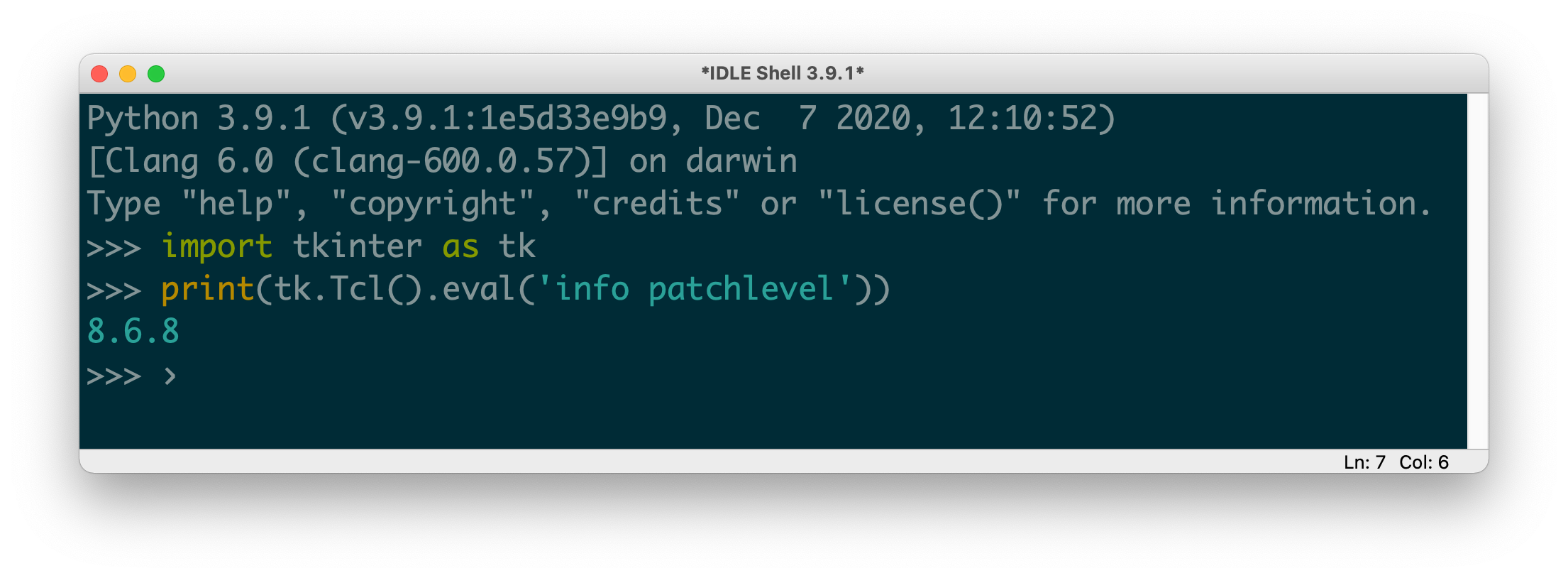
1.10.2.1.1 -- idle in mac big sure -
>>> import tkinter
>>> tkinter.TclVersion, tkinter.TkVersion
(8.5, 8.5)
>>> tkinter._tester()
Traceback (most recent call last):
  File "<stdin>", line 1, in <module>
AttributeError: module 'tkinter' has no attribute '_tester'
>>> tkinter._test()
macOS 11 or later required !
Abort trap: 6
Python may not be configured for Tk
$ python
Python 3.10.4 (main, Apr 26 2022, 19:42:59) [Clang 13.1.6 (clang-1316.0.21.2)] on darwin
Type "help", "copyright", "credits" or "license" for more information.
>>> import tkinter as tk
Traceback (most recent call last):
  File "<stdin>", line 1, in <module>
  File "/usr/local/Cellar/python@3.10/3.10.4/Frameworks/Python.framework/Versions/3.10/lib/python3.10/tkinter/__init__.py", line 37, in <module>
    import _tkinter # If this fails your Python may not be configured for Tk
ModuleNotFoundError: No module named '_tkinter'
solution
$ brew info python@3.10
python@3.10: stable 3.10.4 (bottled) [keg-only]
... ...
tkinter is no longer included with this formula, but it is available separately:
  brew install python-tk@3.10
... ...

$ brew install python-tk@3.10
==> Downloading https://ghcr.io/v2/homebrew/core/python-tk/3.10/manifests/3.10.4
######################################################################## 100.0%
==> Downloading https://ghcr.io/v2/homebrew/core/python-tk/3.10/blobs/sha256:6a937be1fd531589ef7f9b4d971cb91ee7549d99f7f1aaf97f0fc3c0911f1c5d
==> Downloading from https://pkg-containers.githubusercontent.com/ghcr1/blobs/sha256:6a937be1fd531589ef7f9b4d971cb91ee7549d99f7f1aaf97f0fc3c0911f1c5d?s
######################################################################## 100.0%
==> Pouring python-tk@3.10--3.10.4.monterey.bottle.tar.gz
==> Caveats
python-tk@3.10 is keg-only, which means it was not symlinked into /usr/local,
because this is an alternate version of another formula.

==> Summary
☕️ 🐸  /usr/local/Cellar/python-tk@3.10/3.10.4: 5 files, 132.6KB
==> Running `brew cleanup python-tk@3.10`...
Disable this behaviour by setting HOMEBREW_NO_INSTALL_CLEANUP.
Hide these hints with HOMEBREW_NO_ENV_HINTS (see `man brew`).

$ brew reinstall python@3.10
... ...
venv
[!NOTE|label:references:]
PS1
[!NOTE|label:references:]
$ export VIRTUAL_ENV_DISABLE_PROMPT=1

$ function _venv_info() {
    local printf_format=' [%s]'
    local venv=''
    [[ $# -eq 1 ]] && printf_format="$1"
    [[ -n "${VIRTUAL_ENV}" ]] && venv="${VIRTUAL_ENV##*/}"
    if [[ -n "${venv}" ]]; then
      # shellcheck disable=SC2059
      printf -- "${printf_format}" "${venv}"
    fi
  }
# usage
$ _venv_info "--%s--"
--rmk--
$ _venv_info "(\033[38;5;6;3m%s\033[0m)"
(rmk)

# or using `PROMPT_COMMAND`
$ cat ~/.bashrc
# for venv info
function _venv_info() {
  local printf_format=' [%s]'
  local venv=''
  [[ $# -eq 1 ]] && printf_format="$1"
  [[ -n "${VIRTUAL_ENV}" ]] && venv="${VIRTUAL_ENV##*/}"
  if [[ -n "${venv}" ]]; then
    # shellcheck disable=SC2059
    printf -- "${printf_format}" "${venv}"
  fi
}

export VIRTUAL_ENV_DISABLE_PROMPT=1
COL_SD_PURPLE='\[\033[38;5;98;3m\]'
COL_SD_GREEN='\[\033[32;2m\]'
COL_NONE='\[\033[0m\]'
COL_DEFAULT="\[\033[38;5;240m\]"
COL_RESET='\[\033[1m\]'

PS1="\\n${COL_RESET}${COL_DEFAULT}(\\u@\\h${COL_RESET} \\w${COL_RESET}${COL_DEFAULT}) "
PS1+="\$(__git_ps1 \"- (${COL_SD_GREEN}%s${COL_NONE}${COL_DEFAULT}) \")"
PS1+="\$(_venv_info \"- (${COL_SD_PURPLE}%s${COL_NONE}${COL_DEFAULT}) \")"
PS1+="\\$ ${COL_NONE}"
export PS1
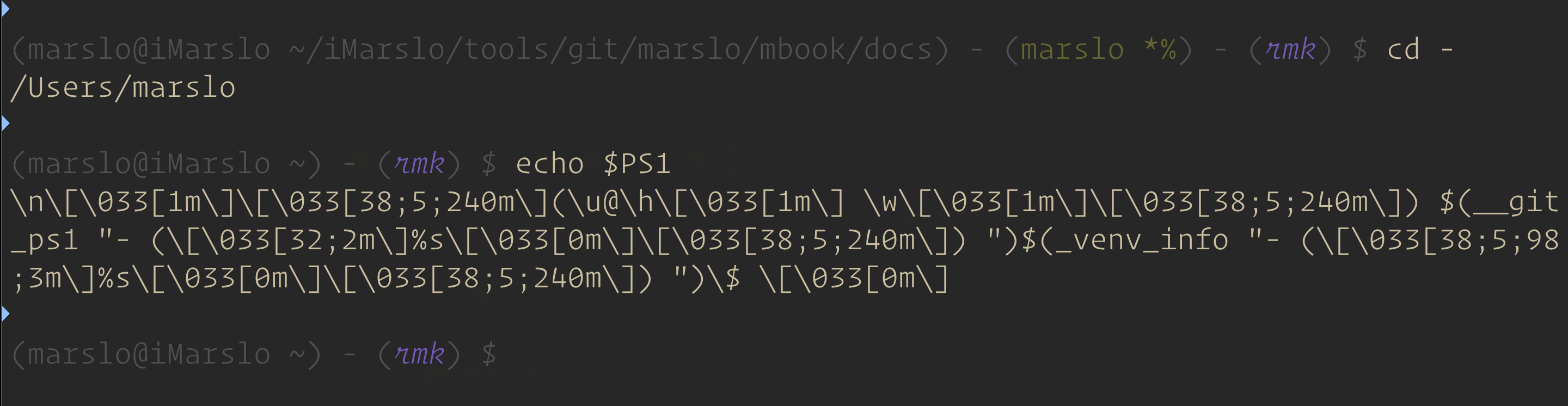
init and setup
[!NOTE|label:references:]
PLATFORM SHELL HOW TO ACTIVATE posix bash/zsh source <venv>/bin/activateposix fish source <venv>/bin/activate.fishposix csh/tcsh source <venv>/bin/activate.cshposix PowerShell <venv>/Scripts/Activate.ps1Windows cmd.exe <venv>\Scripts\activate.batWindows PowerShell <venv>\Scripts\Activate.ps1
# init
$ python3 -m venv ~/.venv/rmk

# enable
$ source ~/.venv/rmk/bin/activate

# disable
$ deactivate
tips for g:python3_host_prog in nvim
let g:python3_host_prog = expand( substitute(system('command -v python3'), '\n\+$', '', '') )
$ pip config -v list
For variant 'global', will try loading '/Library/Application Support/pip/pip.conf'
For variant 'user', will try loading '/Users/marslo/.pip/pip.conf'
For variant 'user', will try loading '/Users/marslo/.config/pip/pip.conf'
For variant 'site', will try loading '/Users/marslo/.venv/rmk/pip.conf'
install packages
[!NOTE|label:references:]